
Noble Foods is the UK’s leading vertically integrated egg business. A complex, multi-site operation spanning farming, milling, egg packing, poultry, and green energy.
As the organisation has grown, so has the need to develop leaders who could think beyond their own function. The Future Leaders programme cohort – drawn from commercial, milling, health and safety, environment, green energy, accounting, and HR – needed more than functional expertise.
They needed a shared language, broader commercial acumen, and the confidence to lead through uncertainty.
Challenges
The challenge wasn’t identifying the right people. It was finding a development experience that would expose them to the complexity of running a whole business, not just their corner of it, and create the kind of shared insight that sticks.
We used a cross-functional business simulation to accelerate commercial thinking, strategic decision-making, and courageous leadership among Noble Foods’ Future Leaders programme cohort.
Actions
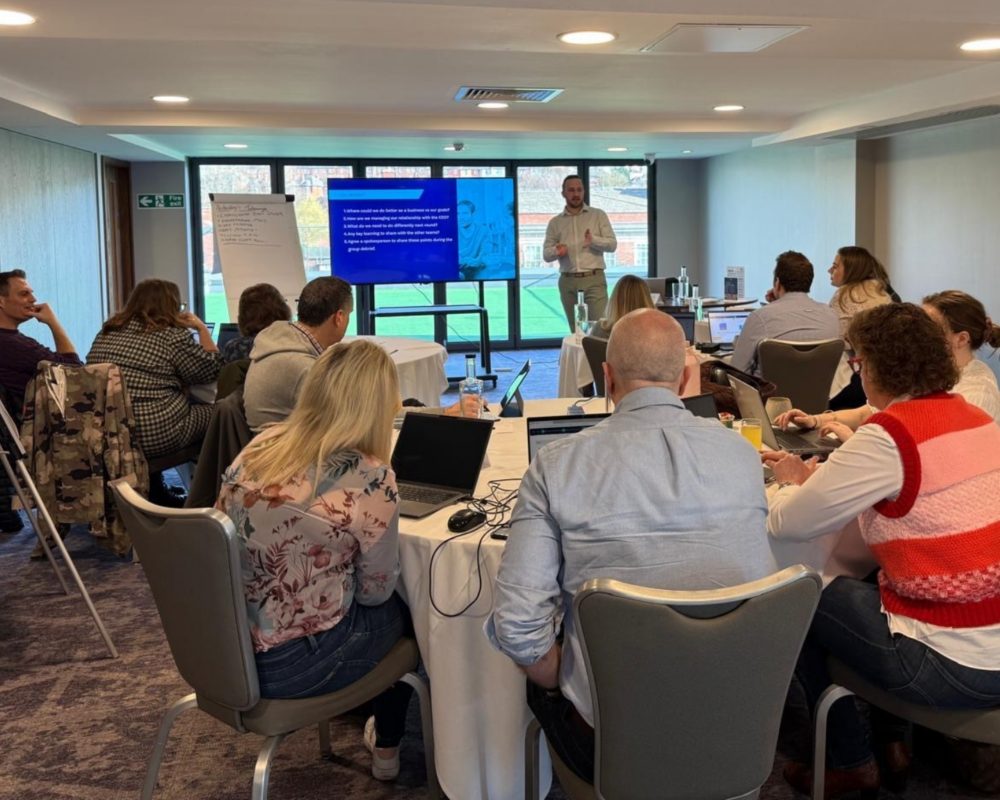
The group came together in Lincoln to run ‘Netbox’, a fictional streaming company, through four quarters of financial turbulence and competitor pressure. Three teams – Shenanigans, Stream Team, and Movie Masters – competed in the same market, making real decisions on pricing, investment, customer strategy, and stakeholder communication.
Every decision fed directly into a financial model. There were no easy answers and no places to hide. The CEO role was played by Louisa Hogarty, Chief People and Impact Officer at Noble Foods, whose high expectations made the experience feel authentic and consequential.
The simulation was built around eight leadership themes, each designed to surface a gap between what participants assumed they understood and what the results revealed. These were:
- Goals drive everything: frame them carefully
- Set a strategy, hold your nerve, and know when to adapt
- Execution is a skill: decisions under pressure separate the best
- Collaboration is a choice: silos are not inevitable
- Customer health is a leading indicator: protect it proactively
- Business acumen means knowing which numbers to look at and why
- Acquisition without retention is an expensive treadmill
- High-performing teams align fast on goals, roles, and trust
Outcomes
The results achieved reflected genuine leadership growth. Across four simulated quarters, the three teams collectively generated $20.4 billion in revenue and $4.10 billion in operating profit. Two of the three hit the CEO’s 15% profit growth target. All three finished with customer satisfaction at 99.5%, up from an opening benchmark of 89.6%. Organisational health averaged 97.5% across the cohort.
Our facilitator, Business Simulations, has delivered hundreds of sessions and noted this as one of the strongest performances he’s seen. The journey was just as significant as the outcome: by the final round, teams that had been reactive and siloed to begin with were proactively managing stakeholder relationships, balancing competing metrics, and making acquisition decisions with genuine commercial logic.
The three team identities will carry forward into the next phase of the programme; real-world business projects beginning in April, along with the shared frameworks, language, and experiences built during the simulation.
“Every time a paper or update goes to the board, it must tell the story – not just report the numbers. That is what I need from the leaders in this business.” Louisa Hogarty, Chief People and Impact Officer, Noble Foods
Of Noble Foods’ six TO CARE values, Together, Ownership, Courage, Action, Respect, and Excellence, Courage was the one that showed up most vividly during the simulation.
One participant raised a concern about cutting customer service investment. Her team moved on. She raised it again. They moved on again. She raised it a third time. That isn’t stubbornness; it’s the willingness to hold a position that matters, even when the room has decided otherwise.
In the final debrief, another participant challenged the group’s entire definition of success. While everyone focused on the CEO’s stated targets, she demonstrated that measuring performance by gross margin told a very different story and put a different team at the top. Spotting a performance dimension outside the formal scorecard and raising it publicly, in front of peers and senior leaders, is exactly the kind of commercial courage that separates good leaders from great ones.
“I learnt that you need a mix of people to ensure good, rounded decision-making. Collaboration needs to be a good use of time; structured and targeted.” Participant
What made this intervention effective was not the simulation in isolation, but the continuity. The frameworks, language, and shared experiences from two intensive days will serve as the foundation for real business challenges ahead. That is the design intent: the best leadership development does not end when the event does.
Feedback
For organisations with high-potential people who are strong within their function but have not yet been stretched beyond it, a well-designed business simulation creates what most programmes take months to achieve: a shared experience, a shared language, and habits that carry forward.
“I discovered the wider implications of strategy and how strategic decisions are critical to the health of an organisation” Participant
The Noble Foods Future Leaders programme is sponsored by Louisa Hogarty and developed in partnership with Esendia, a leadership development consultancy providing coaching alongside the programme. The simulation was facilitated by Business Simulations Limited.