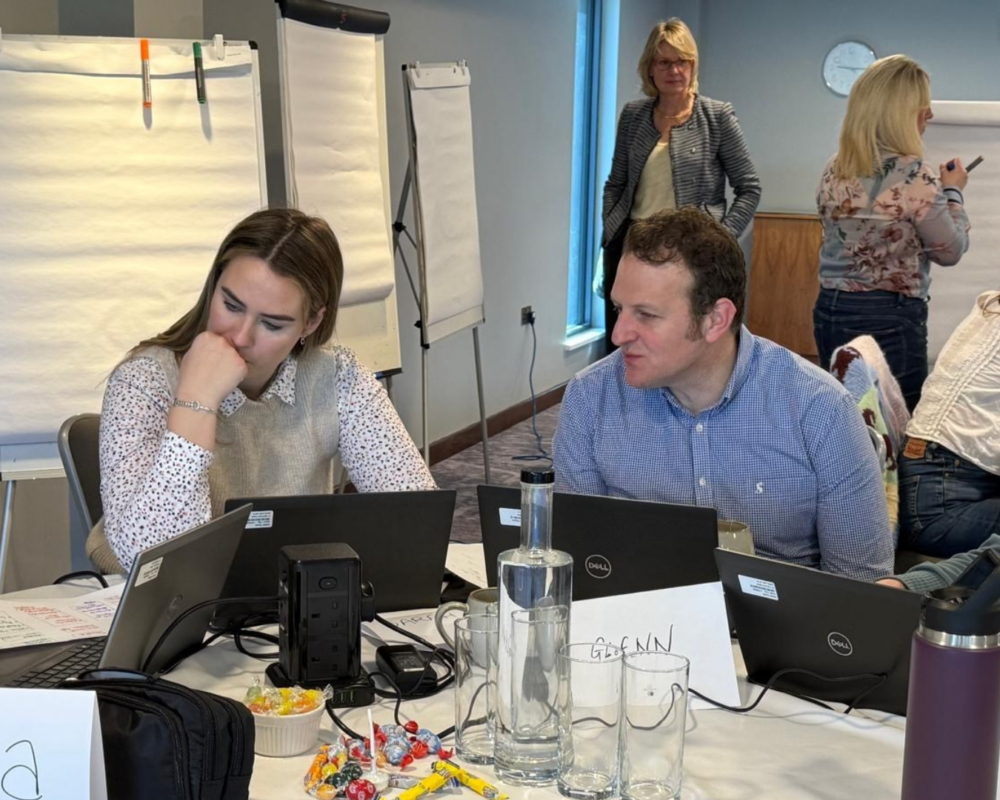
Last month, 11 people from across Noble Foods gathered in Lincoln for what looked, on paper, like an unusual exercise: running a fictional streaming company called Netbox through four quarters of financial turbulence, competitor pressure, and some pretty demanding board conversations.
By the end of it, they had generated a combined $20.4 billion in revenue, hit near-perfect customer satisfaction scores of 99.5%, and, more importantly, walked away with a set of leadership lessons that are already shaping how they think and work back in their real roles.
Here’s the story of why I’m a big believer in business simulations as one of the most powerful development tools available, and what this cohort taught us all about what great leadership looks like under pressure.
The Future Leaders programme
Noble Foods is the UK’s leading vertically integrated egg business, supplying eggs and poultry to major retailers and consumers across the country. Home to brands including The Happy Egg Company, and driven by a purpose to better nourish people, animals, and planet, it is a genuinely complex, multi-site operation spanning farming, milling, egg packing, poultry, and green energy.
The 11 participants were part of Noble Food’s Future Leaders programme; a cohort deliberately assembled from across the business to bring different perspectives together. Commercial foods, milling, health and safety, environment, green energy, accounting, HR. That functional breadth was not incidental: it was the point.
The programme is sponsored and championed by Louisa Hogarty, Chief People and Impact Officer at Noble Foods, who played the role of CEO throughout the simulation and who, it turned out, was an exacting and insightful one! The cohort also benefited from the presence of Inés Wichert, MD of Esendia, the leadership development consultancy working with Noble on the broader Future Leaders journey. Inés attended primarily as an observer: her team of coaches work with participants on a one-to-one basis to develop individual leadership competence, and she also helps oversee elements of the wider programme. The simulation itself was facilitated brilliantly by Tom Parsons, Head of Delivery at Business Simulations Limited, and his handsome assistant, me!!
Why business simulations? The case for learning by doing
Let’s be honest. There is a version of leadership development that happens in a classroom, with slides, frameworks, and careful notes. That version has its place. But there is something categorically different about putting a group of people into a high-pressure environment, giving them a real business to run, and watching what happens.
Simulations work because they create consequences. Every decision the teams made, on pricing, on investment, on how to communicate with their CEO, on whether to collaborate with each other, fed directly into a financial model that gave them immediate, unambiguous feedback. You could not hide behind a good answer in a discussion. You had to back it with a decision.
That is where the real learning happens; not in the frameworks, though they matter, but in the gap between what teams thought they understood and what the results told them. And in this cohort, that gap produced some genuinely sharp insights.
The eight leadership lessons that landed
The simulation was built around eight core themes. Here is what the teams discovered about each of them:
1. Be careful with your goals and objectives – they drive everything you do. The teams were given a clear target from the CEO: grow sales and net profit by 15%. Simple enough. But as the simulation progressed, it became apparent that the way you frame a goal shapes every downstream decision. One team found themselves optimising for metrics that looked good but masked a weaker underlying business. The question “who needs to lose for you to win?” is not just a competitive strategy question, it is a goals question.
2. Have a solid strategy – and change it if it is not working. But avoid mission drift. Every team set a strategy in round one. The ones that performed best held their strategic nerve when early results disappointed, while staying genuinely agile when the market shifted. The temptation to abandon direction entirely when things get hard is real. The discipline is knowing the difference between a strategy that needs time and one that needs changing.
3. You need to execute your strategy through critical decision-making. Strategy without execution is just aspiration. What separated the strongest performances was not the quality of the initial plan, but the quality of the decisions made under pressure, with incomplete information, in real time. That is a skill. It can be practised. The simulation is the practice ground.
4. We have a natural – but irrational – aversion to collaboration. Three teams were competing in the same market. The instinct throughout was to treat each other as rivals. But there were moments where the right move was clearly to share intelligence, coordinate responses to a market shift, or simply talk to each other. Those moments were consistently underexploited. The lesson applies directly back to Noble Foods: functional silos are not inevitable, they are a choice.
5. Always manage your top line – but never ignore your customer base. One of the most striking results from round two was the dip in customer satisfaction when teams prioritised financial recovery over service quality. The rebound required in rounds three and four was costly and difficult. Customer health is not a lagging indicator you manage reactively. It is a leading indicator you protect proactively.
6. Business acumen is much more than simply understanding a profit and loss. One of the cohort’s standout moments came in the final debrief when Alexa from Stream Team pointed out that if you measured performance by gross margin rather than absolute sales or operating profit, a different team looked like the best performer. She was right. The teams had been focused on hitting the CEO’s targets – and two of them did – but gross margin tells you whether the revenue you are generating is sustainable. Understanding a business means knowing which numbers to look at and why, not just being able to read the ones you are given.
7. Always manage your top line – but do not ignore your customer base. Managing revenue is essential. But the teams that chased top-line growth while allowing customer satisfaction to erode found themselves working twice as hard to regain ground in later rounds. The parallel in real business is everywhere: acquisition without retention is an expensive treadmill.
8. You can become a high-performing team fast, if you stick to the basics: goals, roles, and souls. The teams that moved fastest got clear on three things from the outset: what are we trying to achieve, who is doing what, and do we actually trust each other enough to have honest conversations? Goals, roles, and souls. It sounds simple. In practice, most teams skip at least one of them.

The results spoke for themselves
Across four simulated quarters, the three teams, Shenanigans, Stream Team, and Movie Masters, collectively generated $20.4 billion in revenue and $4.10 billion in operating profit. Two of the three hit the CEO’s 15% profit growth target. All three finished with customer satisfaction scores of 99.5%, up from an opening benchmark of 89.6%. Organisational health averaged 97.5% across the cohort.
Tom Parsons noted that this was one of the strongest performances he had seen across hundreds of facilitated sessions. Louisa, as CEO, reflected on the journey the teams had made from Round 1, when communication was patchy and strategic thinking largely reactive, to Round 4, when teams were proactively managing stakeholder relationships, balancing competing metrics, and making acquisition decisions with genuine commercial logic.
And her parting words to the group summed it up perfectly:
“Every time a paper or update goes to the board, it must tell the story, not just report the numbers. That is what I need from the leaders in this business.”
Louisa Hogarty, Chief People and Impact Officer, Noble Foods
Why this matters beyond the room
The Noble Foods Future Leaders cohort will carry their team identities, Shenanigans, Stream Team, and Movie Masters, into the next phase of the programme: real-world business projects beginning in April. The frameworks from the simulation, goals-roles-and-souls, the trust cycle, the Operate-Navigate-Communicate model, will be the tools they apply to genuine business challenges.
That continuity is deliberate.
[pull quote] The best leadership development does not end when the event does. It creates a shared language and a shared set of experiences that a cohort can return to when they face the real version of the challenges they practised.
Noble Foods’ TO CARE values, Together, Ownership, Courage, Action, Respect, and Excellence, were woven through everything we saw over those two days. All six matter. But I’m a big believer that Courage is the most critical one to develop in leaders. It is the hardest to teach, the easiest to suppress, and the most consequential when it is absent.
We saw it twice in ways that genuinely stayed with me.
Emily, from Movie Masters, raised a concern about cutting customer service investment. Her team moved on. She raised it again. They moved on again. She raised it a third time. That is not stubbornness. That is courage: the willingness to hold a position that matters, even when the room has decided to move elsewhere.
Then, in the final debrief, Alexa from Stream Team stood up and challenged the entire group’s definition of success. While everyone was focused on the CEO’s stated targets, Alexa pointed out that measuring performance by gross margin and contribution told a very different story and put a different team at the top. She was right. Spotting a performance dimension that sits outside the formal scorecard and raising it publicly, in front of peers and senior leaders, is precisely the kind of commercial courage and intellectual honesty that separates good leaders from great ones.
From experience, that kind of courage does not just happen. It must be practised, and it has to be safe to do so. That is exactly what a well-designed simulation creates.
A final thought on business simulations
If your organisation has a group of high-potential people who are good at their jobs but have not yet been stretched beyond the boundaries of their function, a well-designed business simulation is one of the most efficient investments you can make. It creates in two days what most development programmes take months to achieve: a shared experience, a shared language, and a set of habits that stick.
We are very grateful to Louisa Hogarty and the Noble Foods team for trusting us with their Future Leaders, and to Tom Parsons and the Business Simulations Limited team for two exceptional days of facilitation.
And to the eleven participants: whatever round of the simulation you are in back at Noble Foods, we hope you are calling your CEO with the problem and the plan!