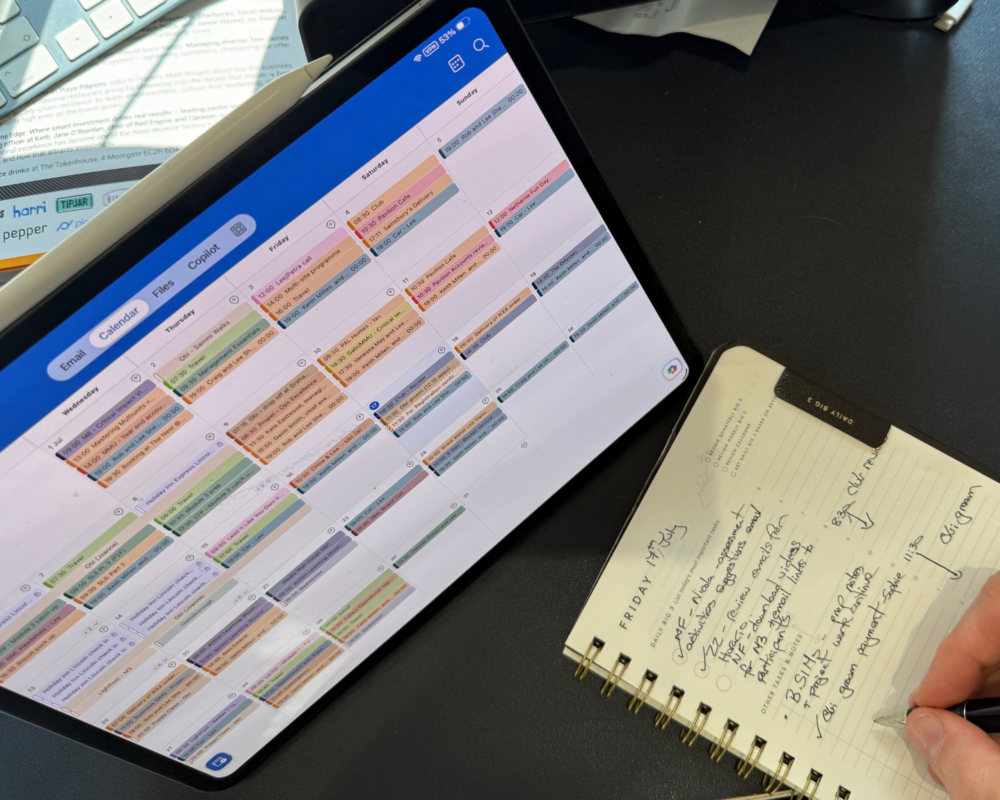
I have a confession, and I’d guess a fair few of you share the same habit. For years, my relationship with time management tools followed a pattern. A new app would launch, promising to finally get my life in order, and within days I’d have signed up, sometimes paid, and spent an entire evening rebuilding every to-do list from scratch. Each time, I was certain I’d found the answer.
The closest I came to actually sticking with something, before I found what I use now, was a Moleskine app. It was their first real attempt at iPad and iPhone planning, built around a natural way of organising your day, and I was genuinely taken with it. The design was clean, it worked smoothly, and for a good while I thought my search was over. But the pattern held. Something new caught my eye, and I switched again, telling myself this was finally the right move.
This time, the something new was the Full Focus Planner. Unlike everything before it, it stuck. Over six years later, having built my routine around Michael Hyatt’s Full Focus system, I still haven’t gone looking for what comes next.
Part of the appeal, if I’m honest, was going back to writing things out by hand rather than tapping them onto a screen, because there’s something about paper that just works for me. That isn’t simply a personal quirk either, because there’s a genuine body of research showing that writing by hand deepens how we process ideas, improves recall, and quietly lifts our sense of commitment and intention in a way that typing on a screen rarely does, which is something I explored in a bit more detail in a separate piece on why handwriting still matters. The bigger pull, though, was that Full Focus genuinely spoke to me about focus, real focus, through the idea of a weekly Big Three and a daily Big Three, both connecting back to the quarterly goals you set yourself. That, for me, was the secret sauce.
Starting with the roles you play
The system begins by asking you to identify the goals you truly want, and it puts real emphasis on something I’d first come across on the FranklinCovey course, The 5 Choices to Extraordinary Productivity, which is the different roles we each play in our lives. Not just work and personal but breaking things down a good deal further than that.
For me, those roles include inside and outside the professional realm, but also being an uncle to my two nephews and being a carer for my father, which matters enormously to me, as well as volunteering as a director of our local community coffee shop, and serving as one of the directors of our village. What the Full Focus system gave me was the chance to crystallise what each of those roles actually means to me, and then to decide whether I wanted a specific goal sitting behind any of them. Sometimes I do, sometimes I don’t, and I’ve never once set a goal against every single role.
What it does do, though, is make you stop and think about what genuinely matters, and to notice that something which feels important in one part of your life might matter far less in another. Let’s be honest, if someone had told me a decade ago that I’d be involved in running a community coffee shop, I’d probably have laughed in their face!
Achievement goals and habit goals
One part of the process that really made me think was classifying goals as either achievement goals or habit goals. An achievement goal is done once it’s done, and that’s rather the beauty of it. Redesigning my kitchen was a couple of quarters of work, and once it was finished, that was that, off the list for good. A health goal is a very different animal, because it’s likely to be with me for a long time, perhaps permanently, with the details shifting along the way. Even at work it’s the same story, where a revenue or sales goal is always going to be there driving performance, even as the specifics change from one quarter to the next. Those are your habit goals, the things you keep doing continuously, rather than a task you tick off once and forget.
If there’s one thing I most want to emphasise, it’s how quietly powerful those two small habits have turned out to be, the thirty minutes a week to set the Weekly Big Three and the ten minutes a day to set the Daily Big Three.
It sounds almost too simple to matter, and yet that regular rhythm of connecting back to what I said was important is the thing that’s moved the needle for me more than anything else.
Why minimalist me?
Going back to the article title, late last year, Full Focus introduced a stripped-back version of the planner, which they call the minimalist planner, and it’s rather changed things for me. They’ve taken out a lot of the pages I’ll happily admit I used enthusiastically when I first started and then quietly abandoned, things like the daily rituals, the morning and workday start-up routines, the workday shutdown, the evening routines, and the pages for mapping out the quarter, which for me always lived in my Outlook calendar anyway. The result is a leaner, cleaner tool that fits how I actually work rather than how I once imagined I might.
There’s one thing I do miss, mind you. The minimalist planner keeps a page for your goals for the quarter, but it’s dropped the individual page per goal where you’d previously capture the detail, the measures, and those first few steps. I think that might be a mistake, because that page forced you to think a little more deeply about what you were really trying to achieve and how you’d know you’d got there. It’ll be interesting to see whether that evolves over time.
This blog is an excerpt from a LinkedIn article. To find out more about focusing on what matters, not what’s ‘urgent’, read the full article here: Minimalist me: how I improved my focus and productivity.